
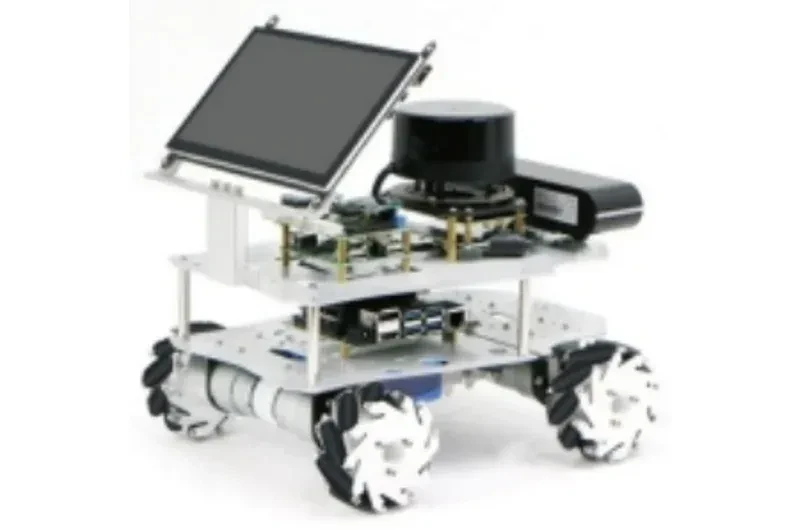
ROS Educational Robot Experiment Development System
This equipment is a ROS autonomous driving educational robot experiment development system. It is based on the ROS main control platform, LiDAR, RGBD depth camera, motion control board, and mobile rob
Product Overview
This equipment is a ROS autonomous driving educational robot experiment development system. It is based on the ROS main control platform, LiDAR, RGBD depth camera, motion control board, and mobile robot platform, combined with an experimental development platform for educational design. The equipment can be used to demonstrate environmental perception, target recognition, gesture recognition, LiDAR mapping and navigation, visual mapping and navigation, fusion positioning and navigation, and voice interaction, meeting teaching needs such as structural cognition, data collection, function verification, navigation debugging, and system integration. It is suitable for vocational colleges, technical schools, and intelligent connected vehicle training labs to conduct ROS autonomous driving-related course teaching and training.
Core Advantages
Real Components and System Demonstration
Using the ROS main control platform, STM32 motion control board, LiDAR, RGBD depth camera, and mobile robot platform, it forms a complete autonomous driving experiment system to demonstrate the structure of intelligent mobile robot perception and control systems.
System Structure and Installation Position Cognition
Displays the installation positions and connection relationships of LiDAR, depth camera, motion control unit, and drive system, helping students understand the functions of each component and the system architecture.
Data Collection and Visualization
Supports the collection and display of LiDAR data, depth image data, target recognition results, map data, and navigation status information, enabling perceptual data visualization teaching.
Installation, Calibration, and Debugging
Supports configuration and debugging of LiDAR and vision sensors, conducting navigation parameter configuration and mapping debugging training.
Perception Function Testing
Supports testing of target recognition, gesture recognition, and sound source localization functions, allowing for experiments in environmental target detection and interactive recognition.
Multi-Sensor Fusion
Supports LiDAR and vision sensor fusion mapping and navigation, demonstrating the process of multi-source perception data fusion.
Algorithm Verification and Secondary Development
Based on ROS and ROS2 development environments, it allows for experiments in mapping navigation, target recognition, and autonomous navigation algorithm verification.
Simulation and Scenario Demonstration
Supports 2D LiDAR mapping navigation, RTAB visual mapping navigation, and fusion navigation scenario demonstrations, verifying the operational effects of different navigation schemes.
Safety Protection and Stable Operation
Uses a mobile robot platform for experimental teaching. The training process should be conducted within a designated test area, with manual takeover and operation management implemented through software control.
Teaching Content & Training Projects
Hands-on training covering the following topics:
- Laser Radar Structure Cognition
- RGBD Depth Camera Structure Cognition
- Laser Radar Installation and Debugging
- Vision Sensor Installation and Configuration
- Laser Radar Data Collection and Analysis
- Depth Image Data Collection and Analysis
- Map Data Collection and Analysis
- Navigation State Data Analysis
- Target Recognition Testing
- Gesture Recognition Testing
- Sound Source Localization Testing
- Voice Navigation Testing
Technical Specifications
| Parameter | Value |
|---|---|
| Dimensions | 270×222×187mm |
| Maximum Load | 6kg |
| Drive Mode | Four-wheel drive, supports differential steering |
| Maximum Speed | 1.4m/s |
| Operating System | FreeRTOS, ROS Melodic, ROS Noetic, ROS2 Galactic, ROS2 Humble |
| Communication Interface | CAN bus, Serial Port |
| Motion Control Board | WheelBoard C30D STM32 |
| ROS Main Control Platform | Orin Nano 4GB |
| Drive Motor | MG513 Metal Gear Reduction Motor |
| Encoder | 500-line AB Phase High-Precision GMR Encoder |
| LiDAR | High-Precision Single-Line TOF LiDAR |
| Vision Sensor | Astra RGBD Depth Camera |
What's Included
- ✓ High-Precision Single-Line TOF LiDAR
- ✓ Astra RGBD Depth Camera
- ✓ MG513 Metal Gear Reduction Motor
- ✓ 500-line AB Phase High-Precision GMR Encoder
- ✓ Orin Nano 4GB Main Control Platform
- ✓ WheelBoard C30D STM32 Motion Control Board
- ✓ CAN Bus Communication Interface
- ✓ Serial Port Communication Interface
- ✓ FreeRTOS System Environment
- ✓ ROS Melodic
- ✓ ROS Noetic
- ✓ ROS2 Galactic
- ✓ ROS2 Humble
- ✓ Four-Wheel Differential Drive Mobile Robot Platform
Product Category
Automotive teaching equipment — suitable for vocational colleges, technical schools, and automotive training institutions.
Get a Quote for ROS Educational Robot Experiment Development System
Contact StarBrain for technical specifications, custom configurations, and delivery timeline.