
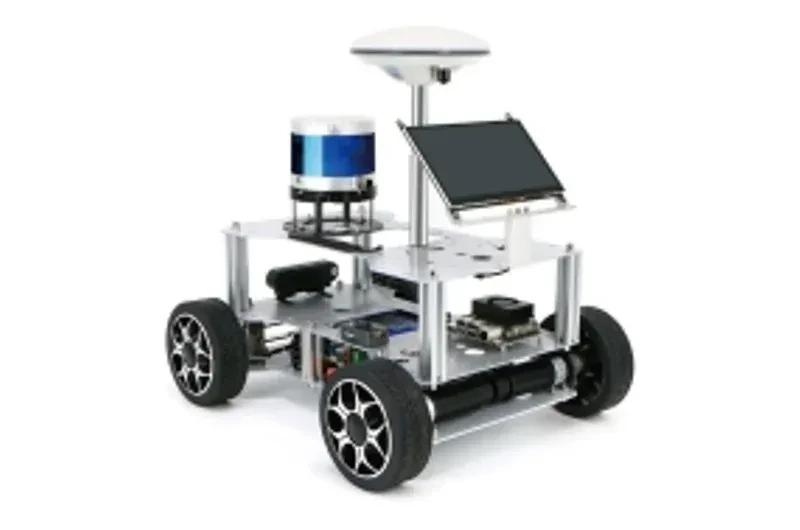
ROS Autonomous Driving Robot Experimental Development System
This equipment adopts a ROS autonomous driving robot platform based on the Ackermann steering structure, integrating the Autoware autonomous driving system and the ROS robot development environment. B
Product Overview
This equipment adopts a ROS autonomous driving robot platform based on the Ackermann steering structure, integrating the Autoware autonomous driving system and the ROS robot development environment. Based on the mobile robot training base, it combines high-precision sensors and computing control units to build a standardized teaching platform. The equipment is equipped with a 9-axis IMU, high-precision 16-line TOF LiDAR, and a stereo depth camera, enabling environmental perception and real-time scene construction capabilities. It can be used for teaching and research training tasks such as autonomous driving robot environmental perception, path planning verification, control algorithm development, and system integration, suitable for vocational colleges, applied undergraduate programs, and intelligent connected vehicle and robotics technology laboratories to conduct related courses and research practices.
Core Advantages
Real Components and System Display
Adopts an Ackermann steering chassis structure, integrating an MD36 brushed DC drive motor, S20F high-torque digital servo, 500-line AB-phase GMR encoder, and Orin NX ROS main control computing unit to build a complete mobile robot execution and control system.
System Structure and Installation Position Cognition
Displays the installation layout and functional relationships of LiDAR, stereo depth camera, 9-axis IMU, drive motor, and steering servo in the mobile robot chassis, used to understand the structure of the robot's perception and motion control system.
Data Acquisition and Visualization
Based on ROS and Autoware systems, it achieves multi-source sensor data acquisition and processing, enabling real-time processing and scene construction of LiDAR point clouds, stereo depth vision information, and IMU attitude data.
Perception Function Testing
Utilizes a 16-line TOF LiDAR and stereo depth camera to achieve environmental obstacle perception, spatial structure recognition, and target detection verification, used for testing the robot's environmental perception capabilities.
Multi-Sensor Fusion
Fuses data from LiDAR, stereo depth camera, and 9-axis IMU to achieve environmental modeling and state estimation, supporting robot localization and scene reconstruction training.
Algorithm Verification and Secondary Development
Provides a development environment based on ROS and the Autoware autonomous driving system, supporting the verification and secondary development training of path planning, environmental perception, and control algorithms.
Drive-by-Wire Chassis Control
Through the STM32 WheelBoard C30D control board and CAN, serial communication methods, it achieves control and feedback collection of the drive motor, steering servo, and motion state, supporting APP and PS2 wireless control methods.
Teaching Content & Training Projects
Hands-on training covering the following topics:
- LiDAR structure cognition
- Vision sensor structure cognition
- Inertial Measurement Unit structure cognition
- LiDAR installation and calibration
- Vision sensor installation and debugging
- IMU installation and configuration
- Point cloud data acquisition and analysis
- Image data acquisition and target recognition
- Position and posture data analysis
- Path planning algorithm testing
- Obstacle avoidance strategy verification
- SLAM mapping and simulation verification
Technical Specifications
| Parameter | Value |
|---|---|
| Dimensions | 445 × 358 × 443 mm |
| Load Capacity | Maximum 10 kg |
| Maximum Speed | 1.3 m/s |
| Drive Wheel Diameter | 125 mm solid rubber wheel |
| Main Control Board | WheelBoard C30D (STM32) |
| ROS Main Control Computing Platform | Orin NX |
| Drive Motor | MD36 DC Brushed Motor |
| Steering Servo | S20F 20kg High Torque Digital Servo |
| Encoder | 500-line AB Phase GMR High-Precision Encoder |
| LiDAR | High-Precision 16-Line TOF LiDAR |
| Vision Sensor | Gemini Pro Stereo Depth Camera |
| Inertial Measurement Unit | 9-Axis IMU Sensor |
What's Included
- ✓ 16-Line TOF LiDAR
- ✓ Gemini Pro Stereo Depth Camera
- ✓ 9-Axis IMU Inertial Measurement Unit
- ✓ MD36 Drive Motor
- ✓ S20F Steering Servo
- ✓ WheelBoard C30D STM32 Control Board
- ✓ Orin NX ROS Main Control Computing Platform
- ✓ CAN Communication Module
- ✓ Serial Communication Module
- ✓ ROS Robot Operating System Development Environment
- ✓ Autoware Autonomous Driving System
- ✓ Ackermann-Structure Mobile Robot Chassis
- ✓ Drive Wheel and Support Structure
Product Category
Automotive teaching equipment — suitable for vocational colleges, technical schools, and automotive training institutions.
Get a Quote for ROS Autonomous Driving Robot Experimental Development System
Contact StarBrain for technical specifications, custom configurations, and delivery timeline.